Monday, November 6, 2017

Overcome your fears

Who hasn't enjoyed sitting through a scary movie?  You know the kind I am talking about. The one that makes the hairs on the back of your neck stand up, make you give up a screech at the right moment and leave you checking the doors and the windows at your home for nights after you have seen it.

Alien. Halloween. Friday the 13th. Nightmare on Elm Street. Saw. And, my favorite, The Shining. 


Fear is so awesome in movies because it plays on your anticipation. You fear the unknown, thus your mind makes what you are anticipating so much worse than it really is. 

That's what made for an interesting e-mail I received from a student I instructed last week. Her biggest fear wasn't Bruce the Shark from Jaws or the Predator. 


No, of all things, it was writing. Sure, she had copy written for the news in the past, but had never really put pen to paper (or fingers to keys) for longer, explanatory pieces.  In fact, she said it was her 'weakest link', and her greatest fear was doing it wrong. After considering her words, I gave her the following advice. I hope it helps those of you who might be afraid of communicating through writing, or in any other medium. 
Fear. Wow. That’s a tough one. I can understand that you want to do your best and impress everyone by not getting it ‘wrong’. 
But, let me ask you … Were you born knowing how to walk? Probably not, right? I mean, if you were like me, you were but a wee helpless baby who couldn’t move. That’s OK. Everyone expects you to start there 
When you took your first steps, did you ever fall over? I bet you did, but family helped pick you up and get you to try again. And try you did. Having raised two sons, believe me, I couldn’t stop them. 
I guess the moral of the story is this, if you want to learn how to write, there is no substitute to trying, failing and trying again.
I assume you are a good typist. If not, pen or pencil and paper will work. Every day, set aside half an hour and write. About your day. About the annoying person who cut you off in traffic. About your dog. About what you had for dinner, and how you made it. About the school you attended as a kid or about your first crush in high school. 
Basically, you are learning how to tell a story in written form. At the end of 30 minutes, put your pen down, save your document, whatever, and then walk away.
The next day, pick it up and read it. What was ‘wrong’ with it? What was ‘right’ with it?  Start writing again. Add to your observations. Take it in a completely different way.
Before long, you will start getting a feel for how the words are generated in your brain. You will get an idea of how you tell a story and how you can communicate with others. 
Keep in mind when it comes to writing that there are two kinds of writers – painters and sculptors.  
Painters take the time to painstakingly consider every single word they put to paper, the same way an artist takes the time to consider every brush stroke. Are you a painter? Do you worry about putting the wrong mark in the wrong place? 
Sculptors tend to throw a lot of words out and hope to chisel something from the mass of material. Me, I am a sculptor. I have to keep trying until I get something out of it. The whole idea that communication is 1% inspiration and 99% editing. 
Is either style better? Nope. Just do it your way, and you will enjoy it.
Before you know it, writing will be easy. You may even pick up a new hobby – journaling. If you do it hand-written, there are plenty of blank essay books you can pick up that you will treasure for years. 
One magazine I used to subscribe to is Writer’s Digest. While it was geared toward professional writers, there are a lot of exercises to get you writing. One I love is when they give you a photo and you have to write a paragraph describing what’s going on in it. Be crazy. Get creative. The more you use the language, the more you can do with it.
I hope this helps…
Musings from a member of the Professional Order of English Majors… 
Tom Iovino
https://www.linkedin.com/in/tomiovino

Thursday, July 14, 2016

Their expertise is elsewhere

It never fails. Whenever I teach a class on media relations, someone trots out an official sounding fact about the decline of reading comprehension in the United States, and how you have to 'dumb down' whatever you are talking about when you address the public.

Go stand in the corner, dummy
I have heard the average reading comprehension drop from 10th grade about a dozen years ago to as low as third grade. Yes, I was told by someone who regularly addresses the public that the average reading comprehension of an American is on par with someone who is about eight years old.

To this, I say Hogwash.

The problem we have isn't that reading comprehension has dropped. No, the problem we have is that we - as specialized communicators - often overlook the fact that our audience knows a lot, but their expertise is elsewhere.

Rock on, my man!
Let me set up an example. You buy tickets to a concert. You go to the show, expecting awesome shredding lead guitar, gut busting drum solos and the lead singer to belt out the lyrics. Do you really want the band to take the stage to deliver a lecture on the importance of hand washing to prevent the flu? Not at $80 a ticket you don't!

What's wrong under the hood?
After the show, with your ears ringing and your adrenaline pumping, you start your car to head home, but it won't shift into drive. After fussing with the shift lever for a while, you call a tow truck to take your car to the garage. When the mechanic comes out to tell you what's wrong with your transmission, do you want her to pontificate about how long it will take to evacuate residents from a barrier island in the event of an approaching hurricane?  Heck no!  Fix the car and let's get moving again!

That's one mighty big heart you have there, doc!
With all of the stress, you notice that you are starting to experience chest pain. You call 9-1-1 and are whisked to the nearest hospital, where a cardiologist takes a look at you. When that doctor comes into your room after running a battery of tests, do you really want him to take the time to advocate for smoke detectors in your home? Of course not. You have more pressing matters on your mind!

Now, from this illustration, would you call any of these people ignorant?  On a third-grade level of intelligence?  Not a chance.  Each of these people has a tremendous amount of skill and knowledge developed over years of study and practice, but not in the field that you are an expert. While the public may do things that drive you mad with exasperation, just remember that they don't have the background in the topic you have. Add to that they also have to juggle getting the kids to practice, do grocery shopping, balance their checkbooks, plan when they will finally get around to painting the house - well, you get the idea.

So, how do we reach them?  Easy. Drop the jargon. Lose the acronyms. Remember you aren't speaking to peers in your discipline, but people who can learn if the information is presented in the right way. In other words, we need to stop looking down on the public we serve and understand a great truth that Albert Einstein grasped so well.


There. Now I will get off my soapbox.

Tom Iovino
https://www.linkedin.com/in/tomiovino

Wednesday, July 6, 2016

Politics and ... Communications?

All politics is local.
           Tip O'Neill, former Speaker of the House of Representatives

If you want to see a great study in the evolution of communications, you need only to look at the world of politics.  After all, it's critical for campaign managers to reach out to the electorate to motivate their supporters to head to the polls on election day.
Communications techniques become especially important in presidential politics in the United States. First, the national scale of the race precludes the individual door-to-door campaigning that a mayoral candidate could conduct in a small town. The four-year cycle between elections also allows different communications technologies to evolve, giving us great insight to how important they have become during the intervening time.

Since the 2016 election cycle is ramping up, now is a good time to take a look back to see how people have effectively used the different media available to them.

James Polk's campaign handbill
Initially, in such a large country where it could take weeks for news to travel throughout the states, newspapers and printed handbills were made available to local election organizers to get people to the polls. Sometimes, they would feature images of the candidates and a few inspirational quotes. Sometimes, wow, if you thought today's campaigns were messy affairs with negative ads, you should read what was said in the campaigns of the 1800s.

President Herbert Hoover campaigning from the back of his presidential train
Once railroad lines started crossing the United States, it became considerably easier for candidates to conduct a true nationwide presidential campaign. And, with those railroad tracks came telegraph lines, which allowed advance notice to supporters to show up at the station for whistle stop campaign speeches. From the days of Abraham Lincoln through Barack Obama, this form of campaign still resonates with Americans, even though new forms of communication have taken over and become far more effective at reaching voters.

FDR conducts one of his fireside chats from the Oval Office
Radio became the next big evolution in communications, allowing the near-instantaneous release of information through the major radio networks. The president considered the most skilled practitioner of radio communications was Franklin D. Roosevelt. During his presidential tenure from 1933 until his passing in 1945, he masterfully utilized the medium during his campaigns and through his legendary fireside chats.  Each of his conversations with the American public, while coming across as folksy and relaxed, was carefully drafted, edited and choreographed to build confidence during some of the nation's most trying times.


After World War II, television became the next big thing. Now, not only could people hear or read about the candidates, they could also see them. That was a big step forward, because studies have shown that the words we choose convey only 7% of the message we communicate. The rest comes from the tone of voice, facial expressions and body language. Dwight Eisenhower was the first candidate to use television ads for his campaign, to great effect. Lyndon Johnson would later use one of the first negative ads to great effect against his opponent Barry Goldwater.

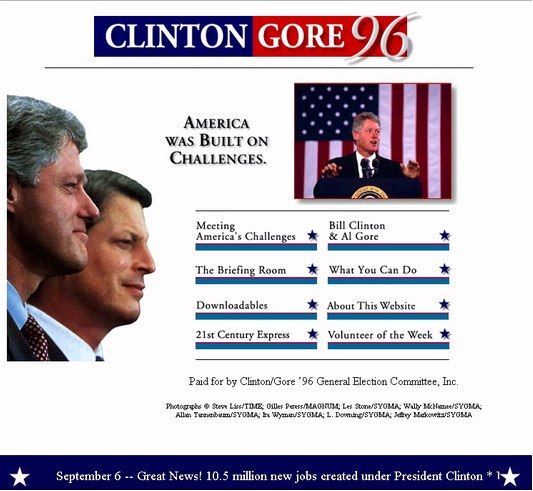
Bill Clinton's 1996 re-election campaign website
While George H. W. Bush was in office and signed the bill that opened the Internet to the public in 1991, it was his successor Bill Clinton that was first able to utilize the power of the Internet on the campaign trail. Granted, winning the web was not all that important in 1996, but those first few brave steps by the Clinton and Dole campaigns opened a whole new political battlefield for those who followed.

Barack Obama's 2008 Facebook page
This, of course, led to what we see today - social media as a political driver. It wasn't until the 2008 contest between Barack Obama and John McCain that Facebook, Twitter and YouTube became important players, but both candidates jumped in eagerly to embrace the new outreach tools. President Obama's campaign was lauded for its skillful use of Facebook in getting younger voters out to the polls, helping ensure his victory.

Who knows what communications outreach tools will help win elections in the years to come. But, one thing is certain, a wise Public Information Officer will take the time to study how people whose mission to communicate effectively with a wide number of residents accomplish their task and apply that knowledge to their communications plans.

Tom Iovino
https://www.linkedin.com/in/tomiovino

Monday, June 20, 2016

When you can't say anything

I am a cinephile. I love movies. There, I said it. 
For the love of movies!  
Whether it's the razor sharp dialogue of Quentin Tarantino's movies, the impeccable filmography of Stanley Kubrick or the masterful storytelling by Steven Spielberg or Martin Scorsese, there's always something to learn from each of the works these directors turn out. 

But, while I appreciate the drama, I do have to confess my love for the slapstick. Caddyshack. Animal House. The Blues Brothers. And, probably my favorite, Airplane


For those who haven't seen this 1980 classic (And, I have to wonder who hasn't), it's the story about an Trans American Flight 209 flying from Los Angeles to Chicago that experienced numerous health emergencies, but couldn't land due to extreme fog. The majority of the action is straight faced, with several absurd sight-gags and exchanges taking place throughout that leave audiences laughing. For instance, there was an exchange between the Pilot Captain Oveur and Dr. Rumack, a physician on the plane who was assessing the health of the passengers:

Dr. Rumack and Captain Oveur fight to control the airplane
Rumack:  Captain, how soon can you land?
Oveur: I can't tell.
Rumack: You can tell me. I am a doctor.
Oveur:  No, I am just not sure.
Rumack: Well, can you take a guess?
Oveur: Not for another two hours.
Rumack: You can't take a guess for another two hours? 
And on from there. And, I realized after those lines were delivered and I wiped away a few tears from laughing so hard, that they are interesting ones when it comes to the world of public information officers.

Think about it. For most of our job, we are out there giving information freely to the public through the media, social media, our websites or whatever. But, there are times when we can't share certain information about what we are doing. 

Many firefighters could find themselves in this situation
For instance, my good friend and mentor retired Tampa Fire Captain Bill Wade told me how he would routinely show up on scenes crowded with reporters. He would get his briefing from the incident commander, come back to the reporters and give them the basics. His messaging in most situations was very simple:
  1. The structure was on fire
  2. We put the fire out
  3. The cause is under investigation
Now, why wouldn't he give the details as to what happened to cause the fire?  There could be a bevy of reasons, first and foremost is that the fire inspectors haven't yet had the opportunity to determine exactly what caused the fire. Could it have been an overloaded fusebox with a penny filling the gap in one of the slots? Could it have been arson?  Who knows, but the last thing that you would want to do is speculate. So, if you can't comment on something pending an investigation, say, "I don't know, but I can find out."  

Another important thing to remember are the laws in your jurisdiction may prevent you from releasing certain information. The Health Insurance Portability and Accountability Act (HIPAA) prevents the release of a tremendous amount of information. From patient names  and conditions to current or past diagnoses can be withheld from release. So, be sure to know what is covered. A quick call to your agency's attorney can help sort this out for you.

Talk to the hand, because the face ain't listening.
What you shouldn't do, however, is just not give out the information because you don't want to. Sure, we get upset with members of the media from time to time, but just keep in mind that the first amendment's freedom of the press in the United States, as well as local public records laws trump your desire to seek your revenge against a reporter who may be pushing your buttons. 

Always be sure you are in compliance with your local laws, or you may find yourself having to talk an airliner down with an emotionally disturbed fighter ace at the helm in the cockpit. The little room at the front of the plane. And, yes, I'm serious, and stop calling me Shirley. 

Monday, June 13, 2016

Who's safe?

Well, it's been a while, hasn't it?

Yes, nearly six months has passed since the last PIO Chronicles post, but I want to ensure you that I am still alive and well. There have been some major changes in my life that I really don't want to go into right now, but thank you all for your concern!

It's interesting that some of you have been wondering about my well being. For me, I just needed some time away from the computer to get my act together.

For many other Floridians, though, this week has brought unimaginable pain, as a radicalized militant assaulted the Pulse nightclub in Orlando -  just a short drive down from I-4 from where I live.

A shooting victim is carried from the scene by bystanders
At the time of this writing, there are 50 confirmed fatalities and 53 others were wounded by the intentional fire from the assailant. In the confused first minutes, many patrons couldn't tell what the loud shooting sounds were - perhaps part of the music - until it was too late. Chaos erupted as people ran from the scene to save their lives or hid, hoping the perpetrator would not see them.

In times like the shooting at the Pulse nightclub, immediate access to information was both critical and tragic. The shooter became radicalized after reading ISIL literature online. The owner of the nightclub posted a message on Facebook shortly after the shooting began for patrons to flee as quickly as possible from the premises.

Orlando police officers had to numb themselves to the eerie sounds of the victims ringing phones as loved ones frantically tried to reach them to see if they had escaped the carnage safely.

A heavily armed Orange County Sheriff's Deputy helps to ensure there is no more threat
And, for the first time ever in the United States, Facebook activated its safety check feature. This service, which was used extensively in natural disasters and other attacks as seen in Paris and Brussels, allows users to let their friends and families know they are OK in the aftermath of a dangerous incident. Because I have many friends and colleagues in the Orlando area, it was a relief to see their names come in as safe through the service.


And, finally, as is the case with any and all incidents such as this, I carefully watched the numerous news conferences that occurred. While the high-level dignitaries - Governor Rick Scott, Senators Ben Nelson and Marco Rubio - come with their entourages,  it was good to see just how easily the many local agencies from the City of Orlando and Orange County pulled together to deliver coherent, timely information to an anxious public.

Local officials worked closely with the FBI to help get the word out.
The most important lesson to learn as a public information officer is that any emergency is a local emergency, and the people who live in the communities which are affected often have the best insight when it comes to communications.

My biggest concern, unfortunately, is that we are getting way too much experience at events like these...

Tom Iovino
https://www.linkedin.com/in/tomiovino


Tuesday, December 15, 2015

Wrapped up with a bow

Getting coverage for an event that you hold can often times be a difficult task. I mean, there are so many different competing events, news crews are stretched to their limits and - often times - the PIOs setting up their events fail to think of the most basic elements.

  • What will we see?
  • What will we learn?
  • What can we communicate to our viewers or readers?

We recently faced this conundrum at a holiday public safety event we wanted to hold. The event - a cooperative effort between the Hillsborough County, City of Tampa, City of Temple Terrace and Plant City fire departments, was going to demonstrate a united front, showing how we work together to ensure the safety of our nearly 1.4 million residents during this time of the year.

The first challenge, which proved easy to overcome, was getting everyone in the four departments on board. Given the fact that we are stronger together than separate, it was a no-brainer, and the cooperation couldn't have gone any better. With some hard work and juggling schedules, we were able to line up the City of Tampa's training grounds for the demonstration.

Now, how to get the media's attention?  I mean, lining up a 2 hour long media event had more than a few eyebrows raised. How would we keep the reporters there, and what would we be able to provide them? I mean, if this didn't go off well, we'd look like a bunch of dopes. We had to gift wrap this media availability with everything we could possibly need.


Fortunately, we were able to get a lot of great information out. Bet you didn't know that candles are a huge source of fires this time of the year?  Or that space heaters could lead to blazes if not handled properly?

That was great information, but what the reporters wanted to see was flames. Burning. Combustion. We had PLENTY of that!

Oh Christmas Tree, Oh Christmas Tree, how bright you burn when ignited
How about not watering a Christmas tree?  You do realize that by not giving the tree enough water, it can burn like the dickens. Putting that tree into a home can lead to an inescapable situation in mere minutes. Watering the tree daily is the best way to prevent things from bursting into flame.


And, there's always the question about cooking the holiday dinner. Here in the south, a tradition of frying turkeys is something everyone can get behind. If the bird isn't completely thawed and rocket-hot oil spills onto the open flame of a propane burner, well, you can imagine the fireworks that you can expect to see.

Turkey flambe, anyone?
By the end of the two-hour event, the reporters left with spectacular images, a sheaf of information about holiday fire safety and the material to put together some serious educational material for their viewers and readers.

A holiday safety event wrapped up in a bow and delivered to the public.

Tom Iovino, Public Relations Strategist
Hillsborough County, Florida
https://www.linkedin.com/in/tomiovino

Tuesday, December 1, 2015

"What do you do?"

It's a simple, innocuous question, but for those who run the show at our organizations, it can give them fits.

A fairly innocuous scene
Let's set the stage, first. A reporter shows up on scene at one of your facilities unannounced. They come over to one of the employees raking mulch in the hot sun and ask him or her, "So, what are you doing?"

Oh, please just stop talking already ...
Now, there are three types of responses these workers can have, based on their agency's media contact policies. First, they may have absolutely no guidance from their parent agency. The workers may engage in a lively 20-minute conversation with the reporter about how they love their jobs, how great it is to be out in the field, how it's awesome that the city sprang for such expensive mulch ... oops. Maybe the reporter is looking to find out just how much taxpayer money is being spent on mulch, and now your employee is on camera talking about the price of mulch as the reporter asks more questions.

Silence is golden, duct tape is silver
Another response might be the strict enforcement of a policy where line workers are absolutely under no circumstances allowed to speak with the media. When the reporters arrive, the workers flee the scene or, if the reporter manages to ask a question, the worker fires off a terse "No Comment," or "I'm not allowed to talk with members of the media," and walks away. I mean, come on, it's not like the reporter can't see that that employee is raking mulch.

It's OK to talk about what you are doing
Then there is the third, and probably most optimal way to handle this type of interaction, but it has to start way before the reporters arrive on scene. That is to craft a media contact policy where employees are empowered to speak with reporters about what is is that they are doing, but to refer more difficult or challenging questions to a more appropriate staff member to handle accordingly.

Why adopt this model of media interaction? I think the answer is pretty obvious. It's the Goldilocks effect. Basically,  if you use the first model, you run the risk of having someone who may not know all of the details of the situation to speculate, offer conjecture or just generally run off at the mouth, quite possibly not communicating your organization's message clearly. The second approach is just too hard, and not only shows the reporter that he or she is not welcome, but that the public should be suspicious as well. 

But, that third model, wow. It allows the reporter to get what he or she needs to do the story while putting a welcoming face on the organization, yet still allowing for more qualified staff members to tackle the tough message points. 

Basically, it's just right. 

Tom Iovino, Public Relations Strategist
Hillsborough County, Florida
https://www.linkedin.com/in/tomiovino

Thursday, November 19, 2015

Their most effective weapon

I have been giving a lot of thought as of late to last week's attacks in Paris, and I have come to a conclusion as a public information officer. The terrorists' most effective weapon isn't the AK-47. Nor is it the homemade suicide vest. Nor is it even its willingness to enlist young children and women to participate in its deadly plans.


No, it's most effective weapon is fear and doubt. That's right. Yes, 129 innocent victims were killed, and more than 350 were injured in indiscriminate gunfire and explosions last Friday in Paris, and we mourn their loss. The terrorists' goal, however, is much more grand that simply that.

Terrorists want us to look warily at each other as we go about our business. Maybe find those who look different than 'we' do - like a Sikh wearing his Turban - and single him or her out for retribution. Maybe change those holiday travel plans out of fear that we may become targets of a group's anger.

Veerender Jubbal, an Indian-born Sikh, PhotoShopped to look like an ISIS terrorist
There is only one true defense against that weapon - and that is fact. Pure and simple.

It's been said that a lie can travel halfway around the world while the truth is putting on its shoes. In these confusing times, it's only natural to seek answers, no matter how off-the wall or discredited they may be. It's a need we have as humans. Our brains need to find patterns. Answers. Fill in the blanks. 

Earlier today, I was reading my Facebook feed where someone posted an urgent warning supposedly from the Department of Homeland Security about someone buying a large number of UPS uniforms. Makes sense, right?  If someone wanted to get access to any number of buildings, that would be an ideal way for this to happen.


The only problem?  This is a recycled bit of netlore which surfaced shortly after the September 11 attacks. It has been totally discredited by UPS, the Department of Homeland Security and other sources, yet it continues to make its rounds any time an event like this happens. As practitioners of this craft, we need to get the official, verified information out to the public as quickly and accurately as possible if we are to refute these bits of erroneous information.

And, the most important fact we need to communicate is that the odds of being killed by a terrorist are staggeringly small. So small, in fact, that they fall into the range of one in 20 million. Your odds of dying from heart disease? One in seven. Does that stop you from ordering the double bacon burger at your local fast food joint? Maybe not. A traffic accident? One in 112. Lightning? One in 170,000. It's the sudden, gruesome and heartless nature that makes a Terrorist attack such a shock to the public's mind.


But, we have seen this type of panic before. The movie Jaws brought about fear of sharks after its 1975 release. People feared getting into planes after the 9/11 attacks. Last year's Ebola outbreak caused mass panic whenever someone presented in medical offices with gastric distress. Without a firm knowledge of what the risks are, people are terrible at assessing the danger these things present to them.

At his first inauguration, Franklin Delano Roosevelt remarked:
So, first of all, let me assert my firm belief that the only thing we have to fear is ... fear itself -- nameless, unreasoning, unjustified terror which paralyzes needed efforts to convert retreat into advance. 
In these trying times, let's all be the drivers who convert retreat into advance by denying the terrorists the very weapon they need to win.

Tom Iovino, Public Relations Strategist
Hillsborough County, Florida
https://www.linkedin.com/in/tomiovino

Tuesday, November 17, 2015

It's a gamble

This past weekend, I was in Las Vegas. No, I didn't go for a bachelor party, nor did I go to play any high-stakes gaming. Although, there were plenty of opportunities for that.


No, I was there to do some Public Information instruction for the International Association of Emergency Managers annual conference. Which happened to be held on the Strip in downtown Las Vegas.

In a casino resort named the Paris.


The poignancy of which was not lost on me or any of the other students in the class, given the events which unfolded 5,400 miles to the east in the real Paris last Friday.


When it comes to emergency management, what are we trying to do? Whether it's a hurricane, earthquake, hazardous material spill or a coordinated terror attack, we are trying to prepare ourselves and our residents for the eventuality of low-probability but high-impact events. We want our residents to go about their daily lives, yet understand that they need to be be ready in the event that something should transpire.

Do they know where to go? Are there enough emergency supplies on hand? What would they do in the event a situation began to spiral out of control? Where are the exits to the building, and can they be found quickly.

As I flew home from the training yesterday, I was asked by the flight attendants to review the seat back safety card on both flights from Las Vegas to Tampa in the event that something happened and I had to react quickly should something happen on the flight. Now, the odds of something happening on the flight that would require me to make a hasty evacuation from the plane are pretty slim - almost as slim as me striking it rich at the craps tables in Vegas.

But, would I be ready to take immediate action in the event something did happen?

That's how we need to be thinking when it comes to our roles as Public Information Officers.

Tom Iovino, Public Relations Strategist
Hillsborough County, Florida
https://www.linkedin.com/in/tomiovino

Friday, November 13, 2015

Wanna be a great PIO?

Every day I arrive at the office, run through the 200 or so emails I’ve gotten over night, scan the headlines of the local papers and the wires, make a list of everything I need to check on and then I get on the phone and make some calls. 


One of the most valuable (and potentially one of the worst) resources I have for information as a journalist is the Public Information Officer. When they are good at their jobs, they are great, but they are bad they can make an Assignment Editor’s life miserable. I’ve had the pleasure of working with some really amazing professionals in my 22 years as an Assignment Editor. Men and women who understand that we need to have a symbiotic relationship. Then there are those who act as if it’s chore to do what their job title implies - inform the public.

So what does it take to be a great PIO in the eyes of a journalist?  


First and foremost they need to be accessible. To me that means they check emails and voice mails constantly when on duty and respond to messages of an urgent nature quickly.

When they are off duty they have a system set up where they or someone can be reached if information is needed after hours, while in meetings or while on vacation. We know you don’t work 24 hours a day but someone is always in the newsroom (and we have lots of questions) so empower people in organization to give you a helping hand when you’re not around.

Secondly, they need to be truthful and fair. I’ve had PIOs just flat out lie to me about what’s happening at an incident or given information to a competitor they did not share with me even when asked direct questions. Getting information to the public is not their or my time to settle scores or be petty. We don’t have to be friends but we do have to be professionals so let’s get together after work and talk about why you’re mad at me or my newsroom and work it out so we can come together.

Finally, they should have an idea of how newsrooms work. What’s an assignment editor do? What about a producer? Have you ever been in a newsroom? Set up a tour and meet the folks you talk to on the phone, invite them to your office so they can see what it’s like for you. I’ve personally benefited from doing ride alongs, visiting comm centers and also from inviting communicators, police, firefighters and PIOs into the newsroom to take a look around.  

It helps all of us to understand the challenges we all face so we can work together to keep the public up to date and safe.

AnnMarie Breen, Assignment Editor
WTVD ABC 11, Raleigh-Durham, North Carolina
https://www.linkedin.com/in/annmarie-breen-12ab5680

Tuesday, November 10, 2015

Presentation Pointers

There's nothing quite like a PowerPoint presentation to make things exciting. As a public information officer, either you may have to deliver one, or you may have to generate one for another spokesperson in your organization. And, that's cool. Seriously.


I mean, think of the good old fashioned technology PowerPoint replaced. Hauling around slide projectors or reams of overhead transparencies. This program, created in 1990, allows you to port your presentation - videos and all - to and from wherever you need to go. No fuss, no muss. Bring your own laptop, get your hands on an inexpensive projector and you are in business.

This can be a good thing, or it can also be so absolutely horrid, because I have seen people use and abuse PowerPoint, Prezi, Apple Keynote, Google Slides and other various programs. To the point where I - as a member of an audience - would be willing to throw a chair through a window to make good my escape.

While this isn't a post on how to put together a PowerPoint presentation, it can help steer you in the right direction and avoid a few of the most obvious pitfalls.


First, let's talk about the things you want to do. Always remember the KISS principle - keep it simple, sucka. Be sure to make your slides as easy to read as possible, keep them to a few points and use graphics that help tell your story. Oh, and be sure to use spellcheck. There's nothing quite as jarring as misspelling a word on your slides ...

What can go wrong with your slide design? Plenty. Remember, the slides on your presentation are guides to help keep you on track and your audience working with you.


You do NOT want to post a slide that looks like this. Trust me, it happens. I have seen department directors who were paid a considerable salary prepare slides that look like this. They INSIST that this is how people learn and want to see their presentation done. Let's face it, if you end up turning your back on your audience and read from the screen word-for-word, why are they even there? Just give them a handout and be done with it.


Another don't is to jam your slides full of exciting visual effects, Just because you CAN put them in there, should you?  As you can see from the moving graphic above, all of that excitement can wear your eyes out in a hurry, and it can also distract from your message.


Oh, and when speaking about distracting from messages, jamming a ton of photos onto each slide can detract from your message as well. Sure, a picture is worth a thousand words, but picture-paloozas with images stacked on top of each other are going to be a distraction, even if they are all of cute babies and baby animals. Find one good image that tells your story and go with that.

Having the ability to embed video clips into your presentation can really bring your slide to life. Just remember, however, that each of these programs handles these files in a specific way. Just because the video plays with a single click on your desktop computer doesn't mean it will spring to life if you move it to a new computer for the presentation. Be sure to bring all of your files with you just to be sure you have everything handy. This way, you won't be scrambling, clicking the dreaded black box in your slideshow with no result.


Finally, checking your presentation one last time before you leave for your talk is critical. Sometimes the information changes on the slides or updates need to be made, and you may not realize that this critical data has gone missing until you are in the middle of your talk. Believe me, I have done it, and having to correct your information in front of a large group can be one of the most embarrassing things you may ever have to do.

Will these tips make you a PowerPoint guru? No, but they just might help you build better presentations that stand out in your audience's mind for all the right reasons.

Tom Iovino, Public Relations Strategist
Hillsborough County, Florida
https://www.linkedin.com/in/tomiovino

Wednesday, November 4, 2015

My go kit

I have a confession to make. I am a PIO who happens to ride mass transit to work. That's right, I take the bus from my home, across Tampa Bay to my office.


Which means I can't keep my go kit in my trunk. So, I have had to make some adjustments on what I bring to work and how I travel with it. I go fully self-contained to work with my go kit on my back!

How is it possible? It's actually easier than you think.


First, I have to start with a really good backpack. This one from Swiss Gear has a lot of padding for my back, plus it has a ton of separated compartments, which make it easy to store things where I can grab them easily. I added the nifty orange handle flag so everyone will know it's mine!


In the easy scan pocket closest to my back, I have stashed my own personal Chromebook. It was cheap, it runs PowerPoint presentations, and it is lightweight. I have added the proper cables to connect it to a projector, a wireless mouse and a presentation clicker. This way, I am always good to go if I want to write a blog, do a talk... the works.


Next up, I have my county issued iPad and my binder. Is it redundant? Perhaps. But, this way, I can have the Chromebook up presenting and I can work on other items if another presenter is speaking. I'm not stuck this way. The binder, well, what if my battery runs out?


Also tucked in the backpack are a good supply of business cards, a few pens and markers and some reporter notebooks. I prefer the reporter style notebooks because they fit easily into a pants pocket and the spiral binding allows them to lay flat.


I also have a paper list of phone numbers available because - again - what if I need to get in touch with someone?  The lists have phone numbers for important county contacts, news desks, allied agencies ... the works.


Since I now wear glasses, I have to keep them clean so I can see. The screen cleaner and microfiber cloth can keep the glasses, computer and phone screens spotless, and the hard glasses case also keeps a spare pair of sunglasses at the ready for me. Believe me, working outdoors in the bright Florida sunshine can really do a number on your eyes without some protection.


And, when the bright sunshine gives way to pouring rain, there's no substitute for a good rain poncho. Now, I think I made a mistake by buying a black one. Had I thought about it, something a little brighter and more reflective would have been a wiser decision. Added bonus - the poncho also covers the backpack, keeping its contents dry if I have to head outdoors.


How reliant have we become on electronics? That's why my kit has a TON of mirco USB and Apple Lightning cables in it. I also have a rechargeable battery, a wall plug, a car charger and a charger that also uses AA batteries, so I have lots of options. A pair of earbuds helps if I have to listen to notes (or music after a long day). My Slingshot phone cradle gets tucked in there as well, along with a power strip that not only accepts standard plugs, but also has a pair of USB ports to plug into as well.


While you think about the gear to do the job, you often forget that you are out there as a person as well. That's why I don't go anywhere without a few essentials in the kit including hand sanitizer, a stomach settler, a painkiller, tissues and a few other essentials. A few sport bars that can hold you for a while until you can get a real meal can mean a lot out in the field.

Sure, it seems like a lot, but when you think about it, keeping these items in a backpack right at hand can make your job just a little easier when you have to grab and go. Plus, whenever you get to where you are setting up, it's easy to sling that bag down and use what you need.

Remember the old disaster preparedness mantra - it's better to have and not need than need and not have.

Tom Iovino, Public Relations Strategist
Hillsborough County, Florida
https://www.linkedin.com/in/tomiovino